
How to Choose a Plate Heat Exchanger
A practical guide to choosing a plate heat exchanger: when to choose a brazed, fusion-bonded or gasketed type and what to look out for when making your selection.
Plate heat exchangers are now a standard component of heating, cooling and industrial systems. In practice, they have a significant impact on heat transfer efficiency, energy consumption and the stability of industrial processes. Despite this, plate heat exchangers are often selected incorrectly.
In this guide, we summarize the key decision criteria for choosing the right plate heat exchanger, explain the differences between the types and highlight what to watch out for in real-world operation to avoid performance losses, system instability or unnecessary maintenance.
Which type of plate heat exchanger is best suited for industrial applications?
In practice, the first step when choosing a plate heat exchanger is determining the type of construction. The construction determines how the equipment will perform in real operation, as well as the maintenance a životnosti zařízení.
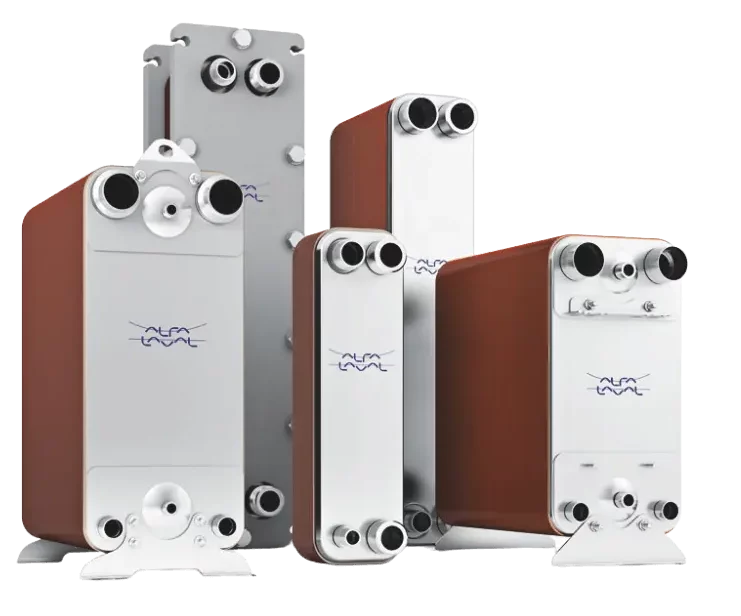
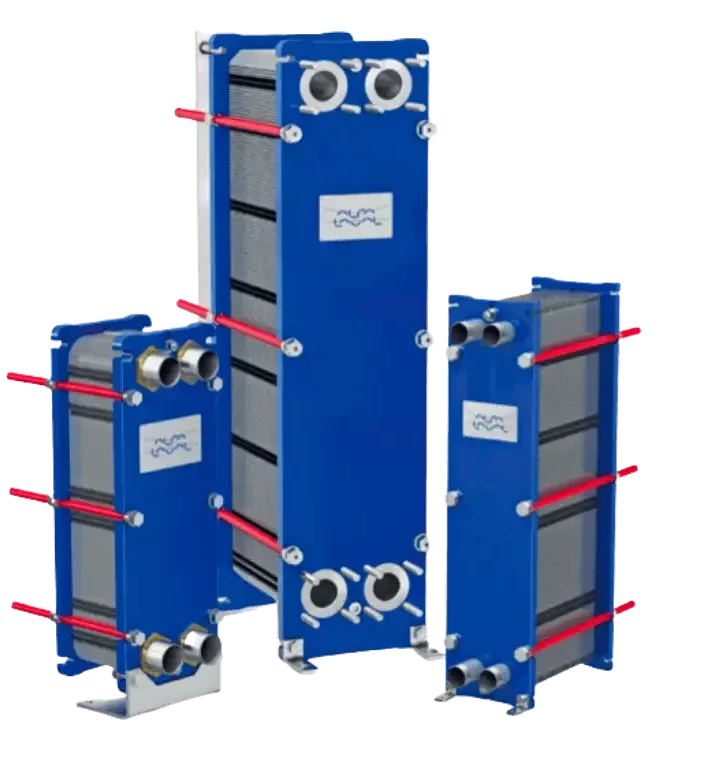
Setkáváme se především s těmito typy deskových výměníků:

Input data: the basis for proper selection
The selection of a plate heat exchanger always starts with the input data and operating conditions. If any of these parameters are underestimated, this will only become apparent during actual operation, i.e. with a delay. For example, through a drop in performance or clogging of the exchanger. Basic parameters for the correct dimensioning of plate heat exchangers:
- type of media
- flow rate of both media
- inlet and outlet temperatures
- pressure conditions
- required performance
We often encounter specifications that include only the required capacity. However, this is not sufficient. Capacity is the result of several influencing factors, not a standalone input parameter.
Don't have exact operating data available? We perform measurements and diagnostics directly at your facility.
Brazed plate heat exchanger – compact solution for clean media
Brazed plate heat exchanger is a compact unit with plates permanently joined together without the use of gaskets. It offers a low purchase cost and a small footprint, but it cannot be disassembled or mechanically cleaned.
When to choose a brazed plate heat exchanger:
- the fluid is clean (e.g., water or glycol without impurities)
- there is no risk of fouling or deposits
- you need a compact solution with minimal space requirements
- the system operates in a closed system with stable operating conditions
Typical industries:
- HVAC systems
- heating and cooling
- heat pumps
- secondary circuits in industry

Fusion-bonded plate heat exchanger – durable solution for demanding media
It offers high resistance to pressure, temperature, and chemical stress and is suitable for aggressive or hygiene-sensitive media (e.g., acids or chemical solutions). Fusion-bonded plate heat exchanger contains no gaskets, which reduces the risk of leaks and contamination.
When to choose a fusion-bonded heat exchanger:
- aggressive or corrosive media
- the fluid must not come into contact with copper (e.g., demineralized water, ammonia, chemical solutions)
- the application requires high chemical resistance or hygienic operation
- the system operates at higher pressures and temperatures in a closed system
Typical industries:
- chemical industry
- food industry
- pharmaceutical and cosmetics industry
- energy
- water treatment

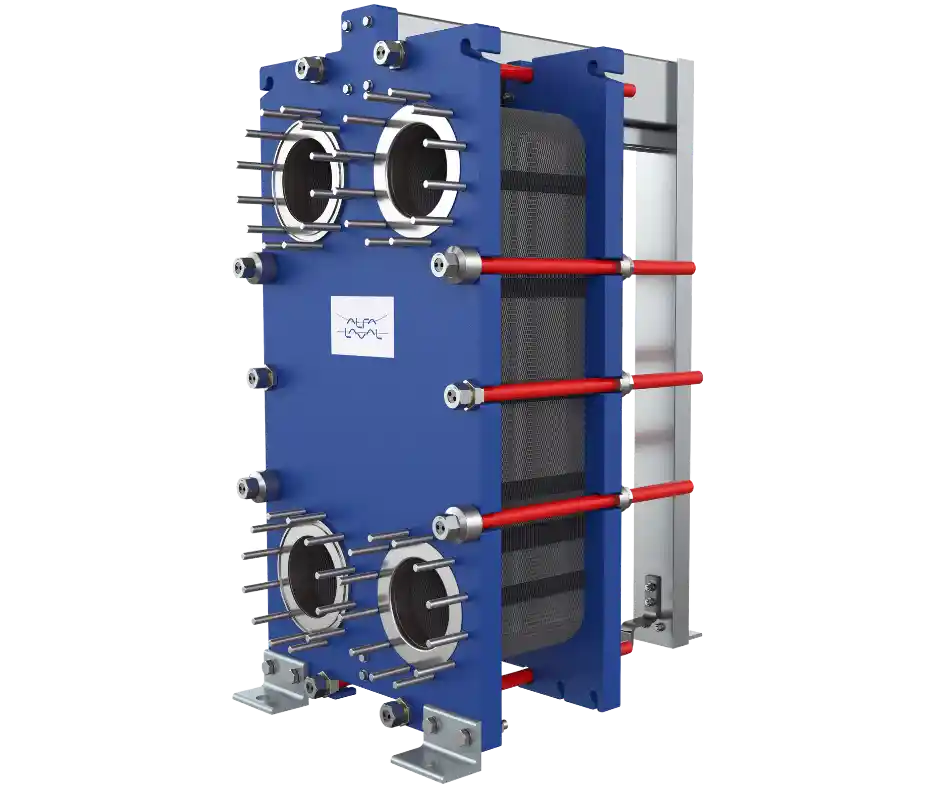
Gasketed Plate Heat Exchanger – Serviceable Solution for Demanding Applications
A gasketed plate heat exchanger is a fully serviceable unit, that allows mechanical cleaning, gasket replacement and performance adjustment by adding or removing plates.
When to choose a gasketed plate heat exchanger:
- scaling or fouling occurs (e.g., limescale, biofilm)
- regular maintenance and cleaning are required
- performance flexibility is required
- the operation requires a serviceable solution
Typical industries:
- engineering and manufacturing
- industrial cooling and heating
- food industry,
- energy and heating
Comparison of plate heat exchanger types
| Parameter | Brazed plate | Fusion-bonded | Gasketed |
|---|---|---|---|
|
Price |
Low |
High |
Medium |
|
Service life |
Medium |
Very high |
High |
|
Medium |
Clean |
Aggressive / hygienic |
Contaminated |
|
Cleaning |
Chemical |
Chemical |
Mechanical + chemical |
|
Space requirements |
Low |
Medium |
High |
|
Performance flexibility |
Low |
Low |
High |
Common mistakes when choosing a plate heat exchanger
Experience from real-world operation and service interventions shows that problems with plate heat exchangers usually do not arise from equipment failure, but from choosing the wrong type for a given application. One of the most common mistakes is selecting a plate heat exchanger based solely on the purchase price.
A brazed heat exchanger may be cheaper initially, but if fouling occurs, it usually means replacing the entire unit. In contrast, a gasketed plate heat exchanger has a higher upfront investment, but significantly lower costs over its lifetime.
Similar issues also arise when the wrong material is selected for chemical media or when the design does not take real operating conditions into account. That is why it is important to always base the selection on the specific parameters of the given operation. Other common mistakes in practice include:
- underestimating fouling and its impact on heat exchanger performance
- choosing the wrong heat exchanger type for the medium
- designing only to nominal values, with no margin for real-world operation
- ignoring pressure drop and its impact on pumps and energy consumption
- an unnecessarily heavy-duty solution (e.g., specifying a fused-bonded unit when it isn’t required)
How to choose the right plate heat exchanger?
The right plate heat exchanger depends on the type of medium and the operating conditions. In simpler, clean systems, a brazed heat exchanger is often the best choice. In chemically demanding applications, an fusion-bonded design is required. In industrial operations with long-term loads, a gasketed plate heat exchanger is the safest option.
The selection always depends primarily on:
- design type
- material
- operating parameters
- service strategy
There is no universal solution; the key is always to adapt to specific operations, not just theoretical parameters. Are you choosing a plate heat exchanger for an industrial application and not sure which one to select? We will design a solution tailored to your operations..