
Expanding metrology: KEYENCE 3D scanner and Leitz Reference 700 CMM
Faster, more accurate quality inspection for CNC parts

In custom CNC production, hundredths of a millimeter often make the difference—along with how quickly and reliably we can verify them. That’s why at Aptec production we’ve expanded our CNC part inspection with two new technologies: non-contact 3D scanning for rapid form verification and coordinate measuring for precise validation of dimensions and geometric tolerances. We now measure on the KEYENCE VL-700 and the Leitz Reference 700.
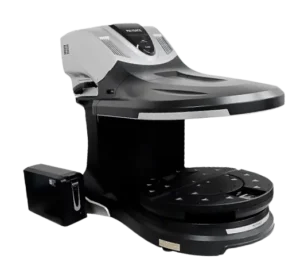
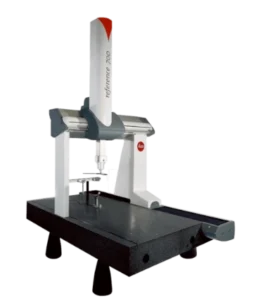
KEYENCE VL-700: non-contact 3D scanning for fast form inspection
Blends, radii, surface transitions and complex geometries can “hide” deviations that only show up later—for example during assembly. The KEYENCE VL-700 scanner allows us to scan the surface of a part in detail, create an accurate 3D model and quickly compare it with CAD data. This reduces inspection time, especially for complex parts, speeds up the evaluation of deviations and provides clear feedback to production on exactly where the part differs from the specifications.
Leitz Reference 700: ISO 10360-2 CMM measurement for tight tolerances
When we measure parts where microns and geometric relationships matter, we use the Leitz Reference 700 coordinate measuring machine. This CMM enables highly accurate CNC part inspection in accordance with ISO 10360-2, which we rely on mainly for critical features such as hole locations, seating surfaces, and geometric tolerances (for example, coaxiality, flatness, or parallelism). Thanks to its articulating probe head, it can measure from multiple angles and reach hard-to-access areas. Depending on the requirement, we choose classic point-by-point measurement or high-speed scanning to keep inspection both accurate and efficient.
Faster part release and more consistent CNC production quality
The combination of 3D scanning and CMM measurement transforms quality control into a precise decision-making tool. In practice, this reduces the time needed to release parts, lowers the risk of deviations becoming apparent during assembly and increases quality stability for repeat deliveries. If you are dealing with machined parts with tight tolerances, functional surfaces or complex geometry, please contact us.