
A technology you won't find in every production
Before the FANTECH LWG 4.0 EXPERT could start welding, we built an entire laser workstation
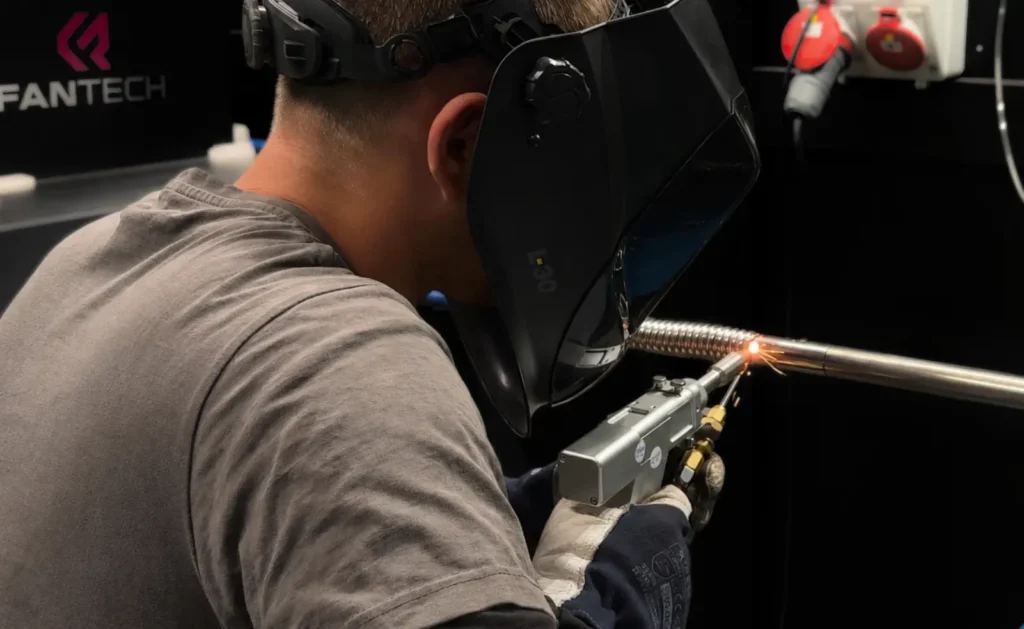
For thin stainless steel and aluminium components, such as heat exchanger station assemblies, controlling heat input is critical to achieving a high-quality weld. Conventional welding can cause distortion that often requires additional rework. That's why we chose laser welding.
What is laser welding and why was it the obvious choice for us?
Laser welding joins metal using a highly focused laser beam instead of an electric arc. It produces narrow, clean welds while minimizing heat input to the surrounding material. This is particularly important for precision parts, where conventional welding can cause distortion or require extensive post-weld rework.
The less a part needs to be straightened, ground or reworked afterward, the more smoothly the entire production process proceeds. Laser welding expands our capabilities precisely in these situations. The speed itself is also a nice bonus. Compared to TIG welding, we can weld 3 to 5 times faster in a number of applications.
FANTECH LWG 4.0 EXPERT
When making our selection, we based our decision on what we produce most often. We chose FANTECH LWG 4.0 EXPERT 1500 W, a mid-range model that handles most of our orders well and perfectly complements our welding equipment. The 1500 W power output provides sufficient headroom for routine production while also enabling precise work even on thin-walled materials. The unit features water cooling, which allows for nearly continuous operation.
Safe laser welding starts with the right welding booth
When we started building our laser welding workstation, we knew that the welding machine alone wouldn't be enough. Laser welding comes with strict safety requirements and meeting them is essential for safe operation. That's why, alongside the laser welder, we also installed a laser safety cabin designed specifically for laser welding. The cabin separates the laser welding area from the rest of the production floor, creating a safe environment for both the operator and everyone else working in the facility.
The workstation is equipped with laser safety eyewear matched to the laser wavelength, interlocked doors that immediately stop the welding process when opened, fume extraction directly at the welding head and comprehensive training for our welders.

The result of months of preparation
The entire project took us several months, from selecting the technology to preparing the workspace and meeting all safety requirements, right through to the actual commissioning. Laser welding is not yet a common practice in engineering operations, so we are pleased that it significantly expands our capabilities in the production of functional assemblies as well as heat exchanger stations.